
Every medical device begins as an idea: a clinician’s frustration, a gap in the standard of care, a sketch on a whiteboard. The distance between that idea and a device that can be manufactured reliably, at scale and under regulatory scrutiny, is where most medical device development projects are won or lost.
Bridging that distance takes more than good engineering. It requires a structured research and development (R&D) process that keeps creativity moving quickly while building the evidence, documentation and manufacturability that regulators, investors and, above all, patients depend on.
Our R&D process is built around a single goal: taking a medical device concept all the way to design transfer, with no surprises waiting on the production line.
Why a Structured R&D Process Matters
In medical device development, the cost of a design decision is at its lowest on day one and rises steeply from there. A structured development process protects the things that matter most:
Speed to market
Fewer late-stage redesigns mean shorter, more predictable timelines.
Regulatory readiness
Design inputs, outputs and reviews are captured as the work happens, building the design history file from the very first day.
Manufacturability
Devices designed with production in mind scale more effectively instead of stalling during pilot builds.
Cost control
A problem found on the bench costs a fraction of a problem found during validation or after a device reaches the market.
The Challenges of Early-Stage Medical Device Development
Translating Clinical Need into Engineering Requirements
A clinical insight is rarely a specification. Turning “this catheter needs to reach smaller, more distal vessels” into measurable design inputs demands close collaboration between clinicians, engineers and quality professionals from the outset.
Iterating Quickly Without Losing Control
Early development thrives on rapid iteration, but every iteration still needs to be traceable. Teams that document too little pay for it during verification. Teams that formalise too much too early risk moving too slowly to learn effectively.
Designing for Manufacture from Day One
A prototype that works in the lab is not yet a product. Material choices, tolerances and assembly methods established during early development determine whether a design can be produced at volume, at the required cost and with consistent quality.
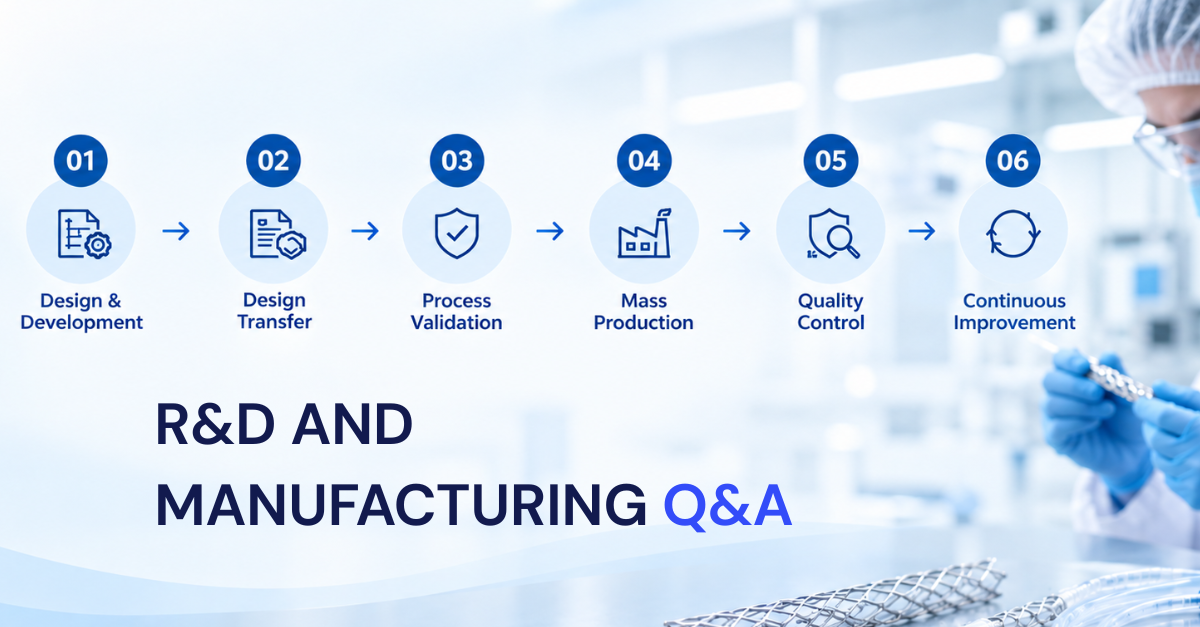
A Four-Stage Approach: From Concept to Production
Rather than treating development as a straight line, our R&D process uses a staged approach with clear gates, fast feedback loops and manufacturing expertise involved from the first sketch.
1. Feasibility and Concept Development
- Structured evaluation of the clinical need, use environment and intended users.
- Early risk analysis and definition of measurable design inputs.
- Concept generation and assessment against performance, cost and manufacturability requirements.
2. Prototyping and Design Iteration
- Rapid in-house prototyping across catheter shafts, balloons, tips and delivery systems.
- Computational modelling to explore design variants before committing to tooling.
- Bench feedback loops measured in days, not months.
3. Verification and Design Freeze
- Verification testing against the agreed design inputs.
- Formal design reviews with engineering, quality and manufacturing at the table.
- A design history file that is audit-ready because it was built as the work happened.
4. Design Transfer to Manufacturing
- Design for manufacturability reviews and process risk analysis.
- Process development, validation and pilot builds on the equipment intended for production.
- A controlled handover, so the device that was verified is the device that gets manufactured.
Together, these stages turn design transfer from a leap of faith into a structured, controlled process.
An Illustrative Journey: A Steerable Delivery Catheter
The example below is illustrative and does not describe a specific customer project.
A medical technology innovator arrives with a clinical insight and a concept sketch for a steerable delivery catheter. During feasibility, that insight is translated into measurable design inputs, and the riskiest assumptions are tested first.
Prototyping then progresses through successive builds, with computational modelling helping narrow the design space before any tooling is cut.
By the time the project reaches design transfer, manufacturing has been involved throughout development. Materials are selected with production requirements in mind, tolerances are assessed against process capability, and pilot builds are conducted using the intended production equipment.
The result is a more integrated development journey, designed to reduce handover-related challenges and avoidable rework between engineering and manufacturing.
From Medical Device Concept to Production
As medical devices become smaller, smarter and more sophisticated, the gap between a promising concept and a manufacturable product continues to widen.
Combining experienced R&D engineers, in-house prototyping, computational modelling and an ISO 13485-certified quality system at our Galway facility supports an integrated approach to medical device design and development.
By considering manufacturing requirements from the earliest stages, development teams can identify potential production challenges sooner and make more informed decisions as a device progresses towards manufacturing readiness.
Have a medical device concept ready to move forward?
Get in touch to discuss your project and explore how our design and development team can support your journey from concept to design transfer.
Contact our team to discuss your medical device development requirements and next steps.