
When selecting a CDMO partner, customers often raise the following question:
“Our product has completed design and development as well as verification. After transferring production to an external manufacturing partner, how can we ensure that mass-produced products continue to meet the original design requirements?”
For implantable and interventional medical devices with complex structures and demanding manufacturing requirements, product performance depends not only on the design itself, but also on factors such as material conditions, manufacturing processes, assembly conditions, inspection methods, and quality controls.
Therefore, design completion is only one milestone in the journey toward commercialization. A key challenge in medical device CDMO collaboration is how to accurately translate verified design requirements into a stable, controlled, and continuously reproducible manufacturing process.
Why Is Process Consistency Particularly Important in Outsourced Development and Manufacturing?
Unlike conventional industrial products, the performance of medical devices is often highly dependent on the manufacturing process. For implantable and interventional devices in particular, certain critical quality attributes (CQAs) are jointly determined by materials, processing techniques, and assembly processes. Potential risks during manufacturing cannot always be fully identified through final inspection alone. Instead, product quality must be continuously ensured through stable and controlled manufacturing processes.
In a CDMO collaboration model, the interaction between the R&D company and the manufacturing partner involves more than simply transferring technical documentation. More importantly, it requires effective transformation of design intent into manufacturing capability.
This means:
- Product design requirements and critical quality attributes can be accurately translated into material specifications, process requirements, work instructions, and inspection criteria;
- Critical processes and special processes are appropriately validated, with clearly defined process windows, inspection methods, and product release criteria;
- Production records, traceability systems, and change control processes support continuous compliance with established requirements across different batches and production stages.
During actual project discussions, customers often raise further questions:
- How are critical quality attributes translated into process control points?
- Is pilot production data sufficient to define process windows?
- After changes in materials, equipment, or processes, how can consistency be maintained among regulatory submissions, manufacturing documentation, and actual production execution?
Ultimately, these questions all point to one core issue: Can design requirements be consistently and reliably replicated through a controlled manufacturing process?
What Risks May Arise from Insufficient Process Consistency Control?
During outsourced manufacturing, if design requirements, manufacturing processes, and quality controls are not effectively connected, risks may impact pilot production, product release, batch consistency, and subsequent change management.
(1) Insufficient Design Transfer Leading to Product Deviations
During the R&D stage, product performance requirements must be fully translated into manufacturing and inspection requirements. If design intent is not effectively transferred to the manufacturing side, potential issues may include:
- Design intent being weakened during process translation;
- Different interpretations of drawings, bills of materials (BOMs), process documents, or inspection standards;
- Lack of corresponding process controls for critical quality attributes.
(2) Unstable Manufacturing Processes Affecting Product Consistency
Common sources of process variation include:
- Changes in raw material batches or critical components;
- Variations in process parameters, equipment conditions, or tooling;
- Differences in operator practices, work methods, or manufacturing environments;
- Variations in inspection method execution.
(3) Risks in Product Lifecycle Management
After a product enters mass production, changes may occur in suppliers, materials, equipment, tooling, personnel, or process conditions.
Maintaining stable mass production does not mean keeping the process permanently “unchanged.” Instead, it means continuously demonstrating that the process remains capable of meeting established requirements under controlled changes.
If changes are not adequately assessed, verified, and documented, the original relationship between design requirements and manufacturing processes may be compromised, affecting product quality consistency and traceability.
Salt’s Approach to Ensuring Process Consistency
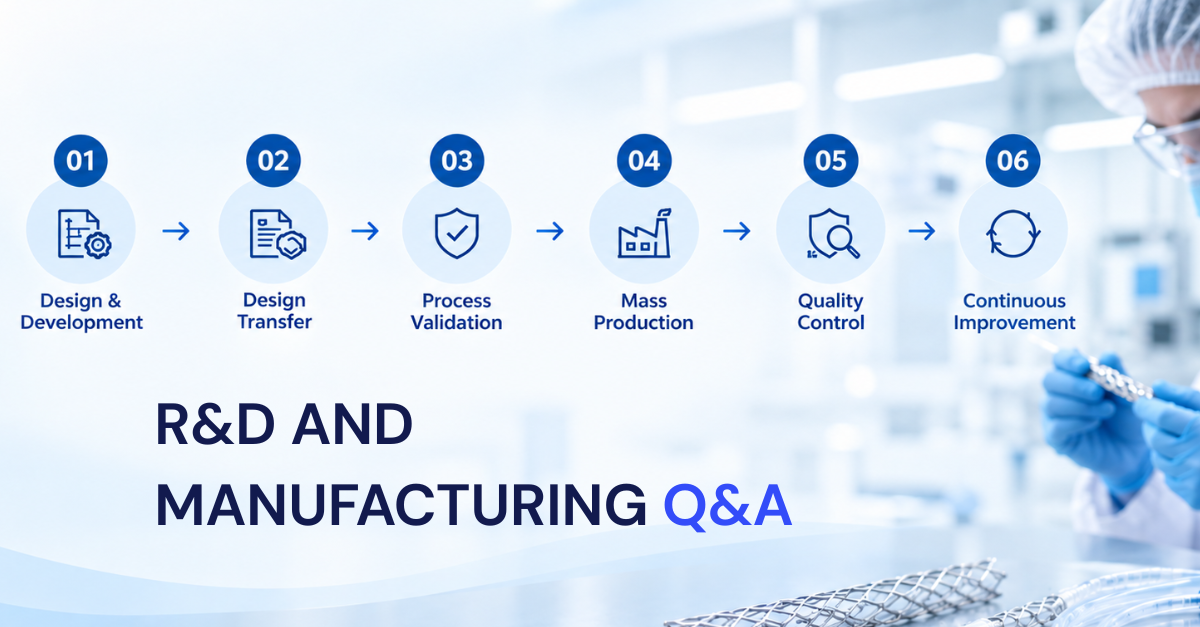
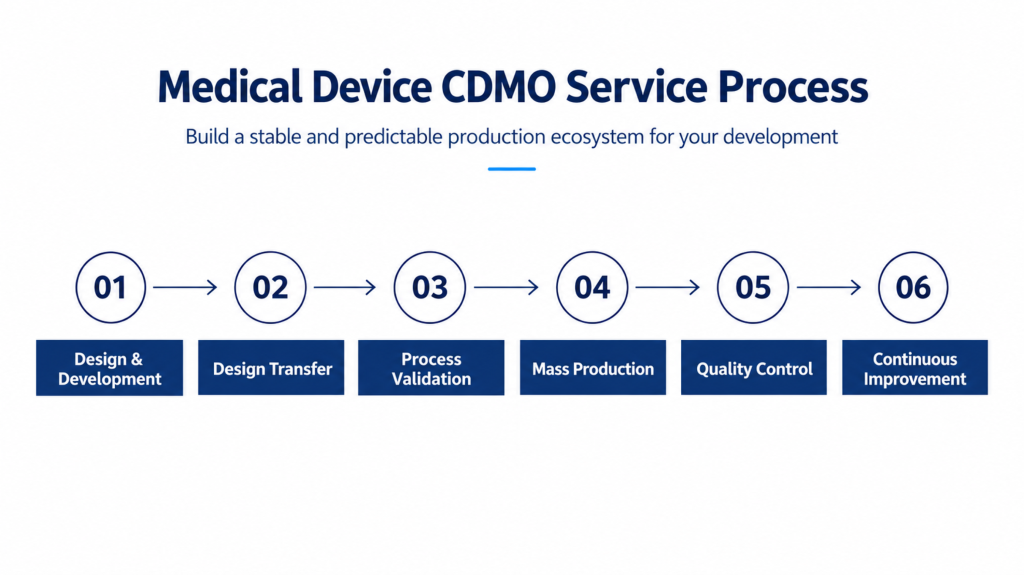
In medical device CDMO projects, process consistency is maintained throughout the entire lifecycle, including design transfer, process validation, mass production control, and continuous improvement.
The Salt team focuses on the following key stages:
Design Transfer: Ensuring R&D Requirements Are Successfully Implemented on the Manufacturing Floor
Common customer question:
After product development is completed, how can we ensure that everyone involved in manufacturing understands and executes the same set of design requirements?
During the design transfer phase, Salt systematically reviews product drawings, materials, performance requirements, and risk control requirements. Critical quality attributes are identified and incorporated into manufacturing processes, work instructions, and inspection standards.
This ensures that design requirements are accurately transferred and effectively implemented throughout production.
Process Validation: Transforming “Can Be Manufactured” into “Can Be Manufactured Consistently”
Common customer question:
If prototype products meet performance requirements, does that mean the product is ready for mass production?
Successful prototype production under a specific set of conditions only demonstrates that the product meets requirements under those conditions. It does not, by itself, prove that the process has the capability for continuous and repeatable manufacturing.
Based on product characteristics and process risks, Salt conducts validation activities for critical processes and special processes. Controlled conditions, key parameters, inspection requirements, and product release criteria are clearly defined, ensuring that manufacturing processes achieve stable and repeatable production capability.
Mass Production Maintenance and Change Control: Ensuring Every Batch Is Traceable and Supported by Data
Common customer question:
During mass production, will changes in raw materials, equipment, or suppliers affect product quality?
Salt establishes interconnected control mechanisms through the integration and retention of information related to material batches, production records, inspection results, deviation handling, and change assessments.
When changes occur in materials, equipment, suppliers, or processes, risk assessments are performed based on the potential impact. Necessary verification activities, documentation updates, and traceability controls are implemented to continuously maintain product quality consistency and traceability.
For customers, a truly reliable CDMO partner is not only capable of manufacturing products, but more importantly, capable of transforming R&D achievements into a manufacturing process that is manufacturable, verifiable, traceable, and consistently reproducible at commercial scale.
Leveraging its integrated R&D and manufacturing collaboration model, robust quality management system, and comprehensive risk control capabilities, the Salt team helps customers achieve a smooth transition from design and development to commercial production, providing reliable support for the continued delivery of innovative medical devices.
Related Insights in Medical Device Innovation